


There is a point when earning more money stops being the biggest financial advantage.
The bigger advantage becomes knowing what not to spend it on.
Financially smart people aren’t necessarily the ones who never buy anything expensive. They can own nice things, travel, eat at good restaurants, and spend money on hobbies they genuinely enjoy.
The difference is that they become increasingly difficult to sell things to.
They stop paying for convenience they don’t use. They stop upgrading things that already work. They stop buying products mainly because everyone else has them. And, perhaps most importantly, they stop confusing spending money with improving their lives.
That doesn’t mean every financially smart person follows the same shopping rules. Someone who loves cars may happily spend more on a vehicle. Someone else may spend heavily on travel while driving an ordinary car.
The common thread is simple: their spending has a job.
Here are nine things they tend to stop buying—or at least become much more selective about.
1. The Latest Version of Everything
Your phone works.
Your laptop works.
Your television works.
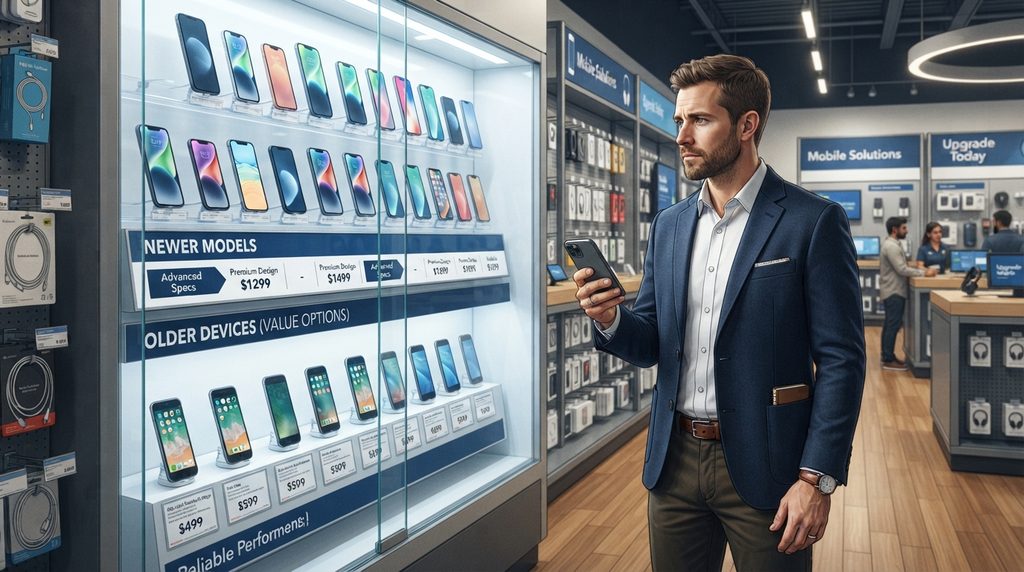
Then a new version arrives with a slightly better camera, a brighter screen, a faster processor and a collection of features you probably won’t notice after the first week.
The temptation is powerful because technology companies are very good at making yesterday’s perfectly functional device feel obsolete.
Financially smart people learn to separate “new” from “better for me.”
If a new phone genuinely solves a problem, replacing the old one may make sense. But upgrading every year simply because an upgrade exists can turn into a surprisingly large recurring expense.
The same principle applies to headphones, smartwatches, tablets, gaming consoles, appliances and other electronics.
A financially disciplined person might ask:
What does the new version allow me to do that the current one cannot?
If the answer is basically “not much,” keeping the old one suddenly becomes much easier.
2. Cars That Stretch the Budget
Few purchases can change a person’s monthly finances as dramatically as a car.
The problem isn’t simply the sticker price.
There is the payment. Then insurance. Fuel. Maintenance. Registration. Repairs. Parking. And eventually depreciation.
A car that looks affordable when you focus only on the monthly payment can become considerably more expensive when you calculate the entire cost of ownership.
Financially smart people don’t necessarily drive old cars. They simply stop treating a car as a measurement of success.
They may keep a reliable vehicle for years after the excitement of owning it has disappeared.
And when they do upgrade, they tend to think about the purchase in terms of the effect it will have on their entire financial picture—not just whether they can technically make the monthly payment.
That’s an important distinction.
Being able to afford the payment isn’t the same thing as being able to afford the car.
3. Subscriptions They Barely Use
This is one of the easiest expenses to ignore because each individual charge feels small.
$9.99 here.
$14.99 there.
Another streaming service. Another cloud-storage plan. A fitness app. A premium membership. A software subscription. A subscription box you forgot you signed up for.
None of them seems dangerous on its own.
Together, they can quietly become a permanent monthly bill.
Financially smart people periodically audit recurring expenses and ask a brutally simple question:
“Would I sign up for this again today?”
If the answer is no, it goes.
The Consumer Financial Protection Bureau specifically recommends tracking spending and distinguishing needs and obligations from wants so people can make more informed decisions about where their money goes.
The goal isn’t to eliminate every subscription.
It’s to stop paying for invisible spending.

4. Cheap Things That Need to Be Replaced Constantly
Cheap isn’t always economical.
A $25 product that breaks every year may cost considerably more over time than a $100 product that lasts for five or ten years.
Financially smart people become increasingly interested in cost per use, not simply purchase price.
They ask:
- How often will I use this?
- How long is it likely to last?
- Can it be repaired?
- Is there a better-quality alternative?
- Am I buying it because it’s genuinely useful or because it’s cheap?
This doesn’t mean automatically buying the most expensive option.
Sometimes the inexpensive product is perfectly adequate.
The point is to stop assuming that the lowest price is automatically the best deal.
A financially smart shopper isn’t necessarily looking for the cheapest thing.
They’re looking for the best value for the way they actually use it.
5. Purchases Made Mainly to Impress Other People
This may be the most expensive category because there is no obvious stopping point.
There is always a nicer car.
A bigger house.
A more expensive watch.
A newer phone.
A better vacation.
A more fashionable neighborhood.
And somewhere online, there is always somebody doing more.
When spending becomes connected to status, the finish line keeps moving.
Financially smart people gradually become less interested in purchases whose primary purpose is communicating something about themselves.
That doesn’t mean they never buy luxury goods.
It means they can enjoy something expensive without needing it to prove anything.
That’s a powerful financial position.
Because when nobody is watching, the pressure to keep upgrading becomes much smaller.

6. Food They Could Easily Have Made at Home
Eating out isn’t a financial mistake.
Neither is ordering delivery occasionally.
The problem appears when convenience becomes the default.
A $15 lunch doesn’t feel particularly expensive.
But $15 several times a week becomes a different number when multiplied across an entire year.
The same applies to delivery fees, service charges and tips.
Financially smart people don’t necessarily stop eating at restaurants. They become more deliberate about when the convenience is worth the cost.
They might cook most weekdays and spend more freely on a dinner they actually look forward to.
That creates a useful distinction:
They aren’t trying to spend nothing. They’re trying to make spending intentional.
And there’s another advantage.
When eating out becomes occasional rather than automatic, it often becomes more enjoyable.
7. Debt-Financed Wants
There is a major psychological difference between buying something with money you already have and buying it because someone has agreed to let you pay later.
Buy Now, Pay Later services have made this distinction even easier to ignore.
A purchase can suddenly appear as four tiny payments instead of one large expense.
But splitting a payment doesn’t make the underlying purchase cheaper.
The Federal Reserve reported that 16% of U.S. adults used Buy Now, Pay Later in 2025, and 11% of BNPL users said a payment had triggered an overdraft or insufficient-funds fee during the year.
That doesn’t mean BNPL is always inappropriate. It means financially smart consumers pay attention to whether financing is helping them manage cash flow—or simply making an unaffordable purchase feel affordable.
The same thinking applies to credit cards.
Investor.gov recommends controlling high-interest credit-card debt, maintaining emergency savings and setting aside money for long-term investing as part of building financial security.
A financially smart person eventually becomes suspicious of the phrase:
“It’s only $50 a month.”
They want to know the total cost.
8. Things They Buy Because They’re on Sale
A discount is not a saving if you didn’t need the thing.
That’s one of the simplest—and most useful—financial rules.
A $200 jacket discounted to $120 is still $120 leaving your bank account.
A kitchen appliance marked down 40% is still an expense if it sits unused in a cupboard.
Sales create a psychological trick: they make the decision feel like making money rather than spending it.
Financially smart people learn to reverse the question.
Instead of asking:
“How much am I saving?”
They ask:
“Would I buy this at full price if there were no sale?”
If the answer is no, the discount may not be much of a deal.
This is particularly useful during Black Friday, holiday sales, flash sales and limited-time online promotions, where urgency can turn an ordinary want into an unnecessary purchase.

9. Lifestyle Upgrades That Arrive Automatically With Every Raise
This one is less obvious.
You get a raise.
Then you move into a nicer apartment.
You upgrade your car.
You eat out more.
You start taking more expensive vacations.
You upgrade your furniture.
Your subscriptions increase.
And somehow, despite earning more money, you don’t feel much richer.
This is lifestyle inflation.
There’s nothing inherently wrong with spending more as your income rises. In fact, enjoying some of the benefits of earning more can be perfectly reasonable.
The danger is allowing every increase in income to become an increase in permanent expenses.
Financially smart people often let their income rise faster than their lifestyle.
If their salary increases by $1,000 a month, perhaps they spend $200 more and direct the rest toward savings, investing, debt reduction or another long-term goal.
The exact numbers don’t matter.
The principle does.
They create a gap between what they could spend and what they choose to spend.
That gap is where financial flexibility begins.
The Federal Reserve’s latest household survey offers a useful illustration of why that margin matters: in 2025, 55% of U.S. adults said they had emergency savings covering three months of expenses, while 30% said they could not cover three months through savings, borrowing or selling assets.
Having money left over isn’t glamorous.
But it gives you options.
The Real Goal Isn’t to Stop Buying Things
There is a trap in personal finance advice where being financially responsible becomes synonymous with never spending money.
That’s not the point.
Money is useful precisely because it allows you to buy things that make your life better.
The goal is to become more selective.
Spend heavily on something you genuinely value if you can afford it.
Spend very little on things you don’t care about.
Avoid debt that turns temporary purchases into long-term obligations.
Keep enough financial breathing room that an unexpected expense doesn’t immediately become a crisis.
And don’t let advertising, social media or other people’s lifestyles decide what “enough” looks like for you.
Financially smart people aren’t necessarily the people with the smallest shopping carts.
They’re the people who know why each thing ended up in the cart.

The Question Financially Smart People Ask
Before buying something, they don’t always ask whether they can afford it.
They ask something better:
“Is this worth what it will cost me?”
Because the true cost of a purchase isn’t always the number on the price tag.
It can be the monthly payment.
The maintenance.
The opportunity cost.
The clutter.
The habit it creates.
The pressure to keep upgrading.
Or the money that could have been quietly building financial security instead.
That’s why financially smart people can sometimes look surprisingly ordinary.
They aren’t necessarily trying to have less.
They’re trying to make sure the things they own—and the money they spend—actually serve the life they want.
And once you start thinking that way, some purchases become much harder to justify.
Not because you suddenly can’t afford them.
But because you realize you don’t want them badly enough.