

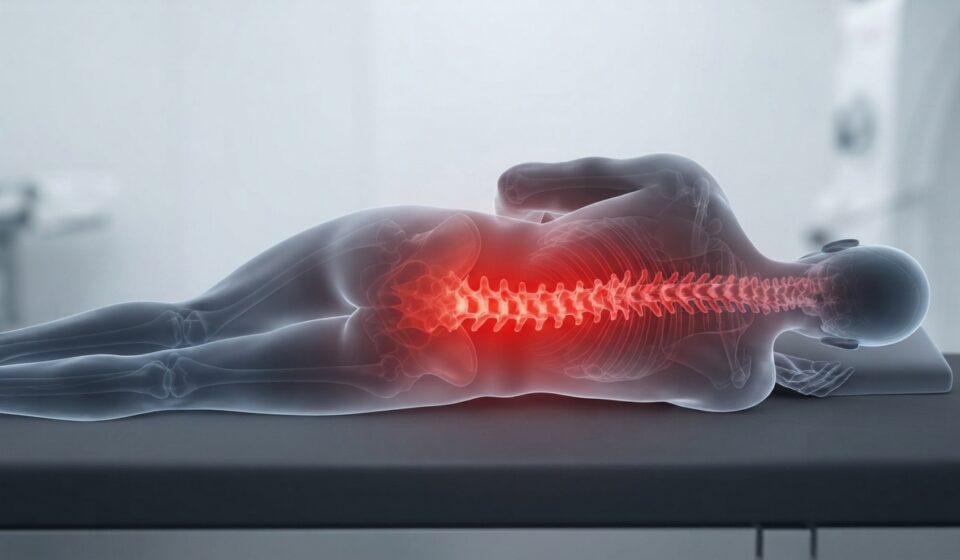
The Best (and Worst) Sleeping Positions for a Healthier Spine
If you wake up with a stiff neck, an aching lower back, or that familiar feeling of having been in a wrestling match all night, your sleeping position might be the culprit.
We spend roughly a third of our lives asleep—that’s about 2,500 hours a year . During those hours, your spine is either resting and recovering, or it’s under strain. The difference comes down to one thing: alignment.
Research published in The Journal of Physical Therapy Science suggests that poor sleep posture is a leading contributor to “waking spinal symptoms”—the stiffness and aches you feel the moment you move in the morning . The goal of any good sleeping position is neutral spinal alignment: keeping your ears, shoulders, and hips in a relatively straight line to minimize mechanical stress on your joints and ligaments .
Here is the definitive ranking of sleeping positions for your spine, from best to worst, and how to make each one work for you.
Best Overall: On Your Back
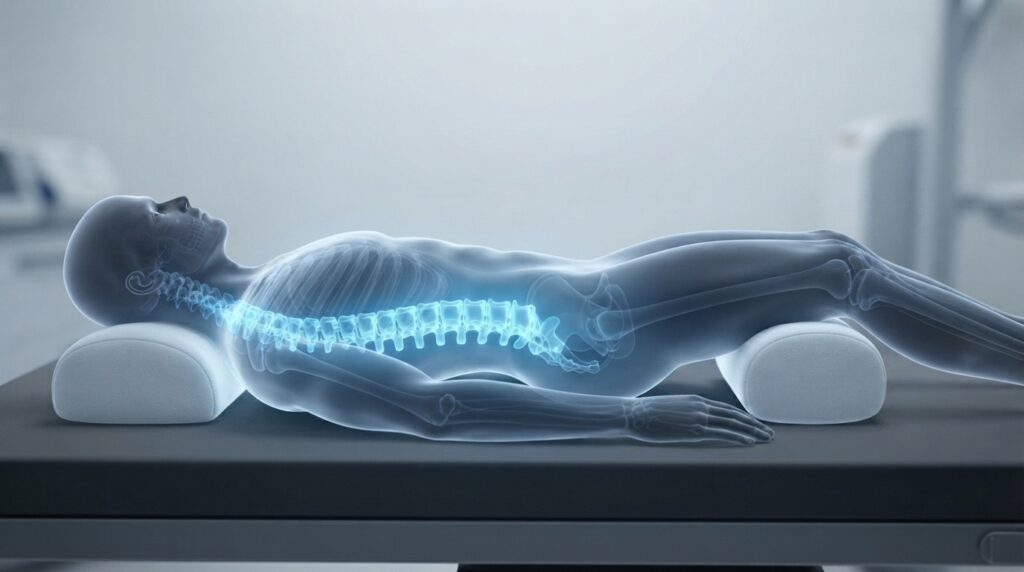
Back sleeping is widely considered the gold standard for spinal health . When you lie on your back, your body weight is distributed evenly across the largest surface area. This minimizes pressure points and allows your spine to rest in a natural, neutral position without unnecessary curves or twists .
A systematic review of six studies found that the supine (back) position supports spinal alignment and is associated with a lower prevalence of low back pain .
However, sleeping on your back comes with a crucial caveat: you need the right support. Gerard Girasole, MD, Director of Orthopaedic Spine Surgery at St. Vincent’s Medical Center, emphasizes that back sleepers must use a pillow like leg rest pillow, or a bolster pillow that supports the natural curve of their neck so that the head stays in line with the spine .
How to Optimize Back Sleeping
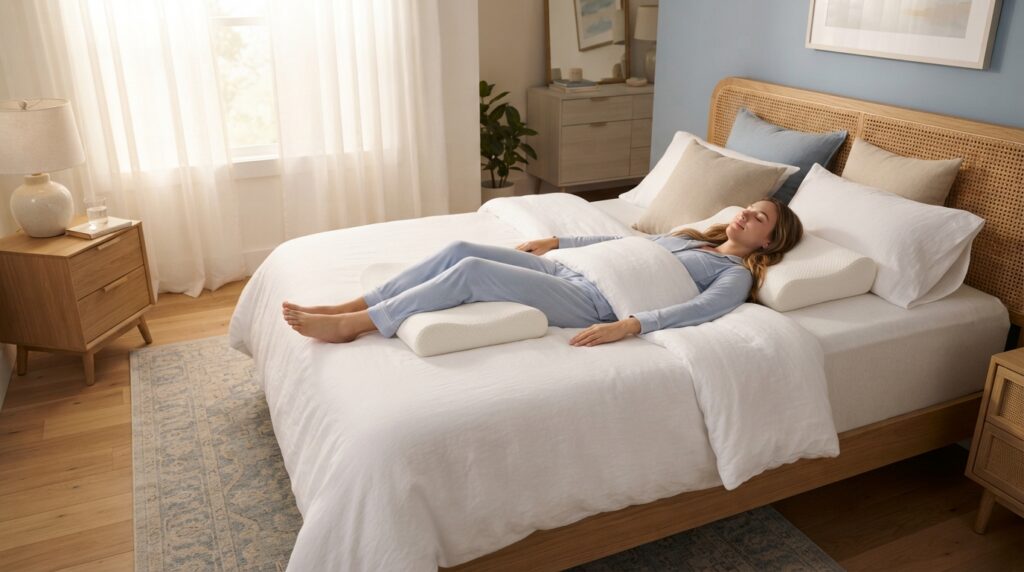
- For your head and neck: Use a cervical or contoured pillow that follows the curve of your neck .
- For your lower back: Place a small, firm pillow under your knees. This flattens the natural curve of your spine slightly and relieves stress on your lower back .
- Your mattress matters: A landmark study in The Lancet found that medium-firm mattresses were significantly more effective at reducing back pain than very firm ones, providing a balance of support and pressure relief .
Who should avoid it: Back sleeping is not recommended for people with sleep apnea or those who snore heavily, as it can cause the tongue to collapse backward and narrow the airway . Pregnant women should also avoid this position because it can decrease blood circulation to the heart and baby .
Best if You Have Back Pain: On Your Side (With Support)
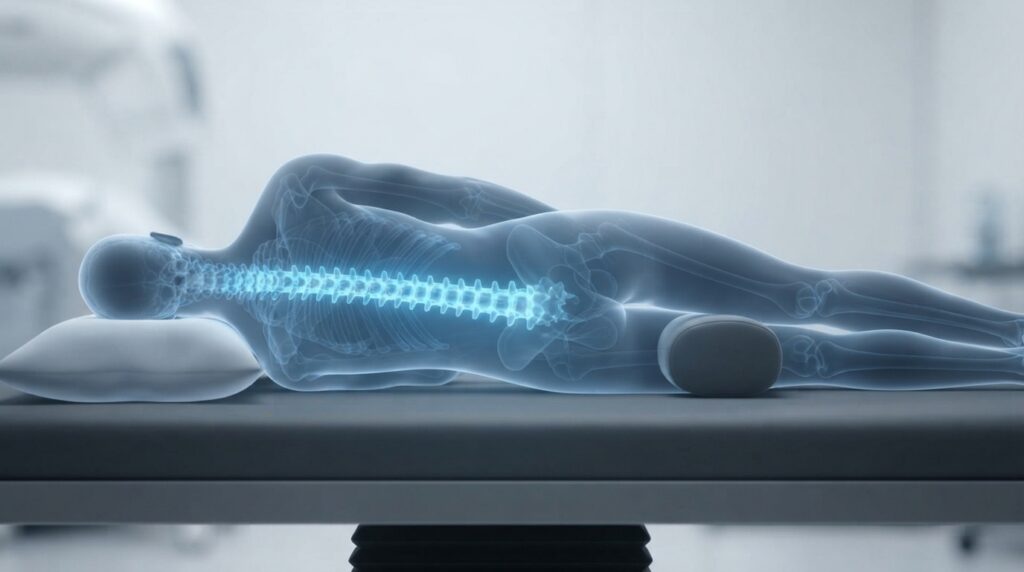
If back sleeping feels unnatural, side sleeping is an excellent alternative—but the details matter.
“Side sleeping can reduce pressure on the spine, but only with the right support,” says Dr. Girasole. “Keep your knees slightly bent, and pay attention to where you place your pillows” .
A systematic review noted that side-lying is the most common sleep posture, and while it is generally good, supportive alignment is key to reducing pain. Poor alignment can actually worsen it .
The most common mistake side sleepers make is allowing their top leg to fall forward, which rotates the pelvis and pulls the lower spine out of alignment .
How to Optimize Side Sleeping
- Between your knees: Place a firm pillow between your knees to prevent your top leg from twisting your pelvis and lower back .
- For your head: Use a pillow that fills the gap between your ear and the mattress, keeping your head level—not tilted up or down. A pillow height of 7–11cm is shown to best maintain the cervical curve .
- For your waist: If there’s a noticeable gap between your waist and the mattress, place a small pillow under your waist for extra support .
Left vs. Right: Research in Nature and Science of Sleep indicates that sleeping on the left side may improve circulation and reduce acid reflux . Side sleeping is also the preferred position for pregnant women and those with sleep apnea, as it keeps the airways open .
The Fetal Position: While many people sleep curled up in the fetal position, it is less ideal. It promotes uneven weight distribution and can cause back pain and sore joints. Try to straighten your body into a relaxed position by untucking your chin and adjusting your knees .
The One to Avoid: On Your Stomach
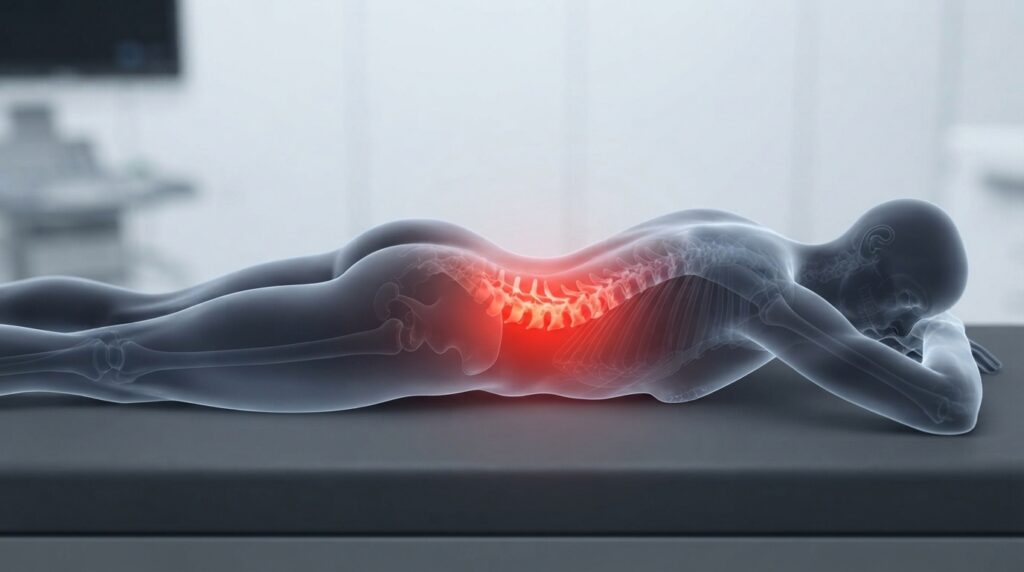
If you sleep on your stomach, you’re putting your spine in the most vulnerable position possible.
“Stomach sleeping arches your lower back and forces your neck to twist to one side—both of which can stress your spine,” says Dr. Girasole. “Unless it’s the only way you can fall asleep, you should try to avoid this position” .
Raymond J. Hah, MD, a spine surgeon with the USC Spine Center, agrees: “This position puts the most pressure on your spine’s muscles and joints because it flattens the natural curve of your spine” . To breathe, you must turn your head to one side, putting a significant compressive load on your cervical joints for hours .
The systematic review of sleep posture and low back pain confirms that prone (stomach) sleeping increases the risk of low back pain due to lumbar strain .
If You Must Sleep on Your Stomach
- Under your pelvis: Place a very flat pillow under your pelvis to prevent your lower back from sinking into an exaggerated arch .
- For your head: Use the thinnest pillow possible—or no pillow at all. This reduces the angle your neck has to rotate to breathe .
The Pillow Strategy
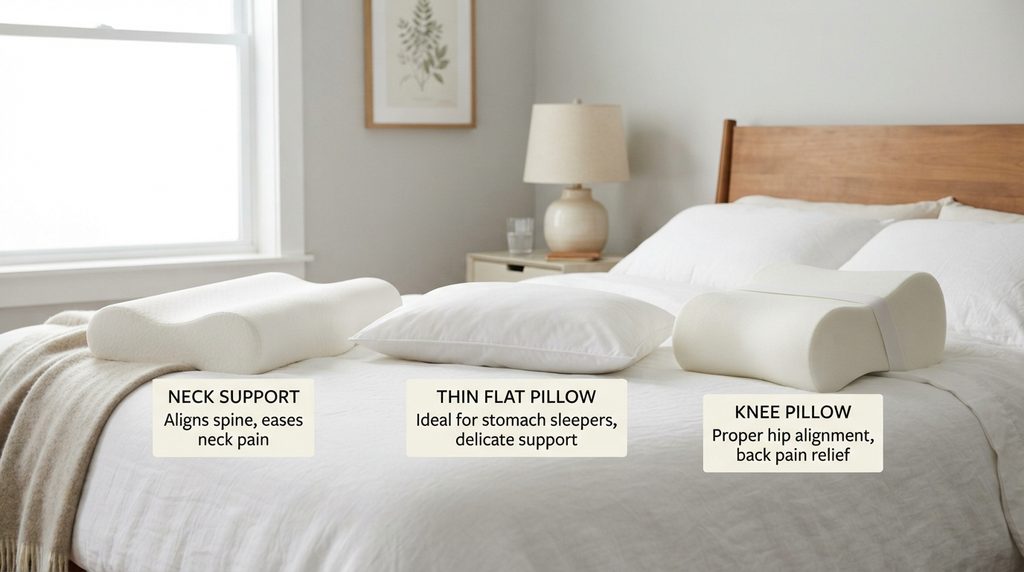
Choosing the right pillow is just as important as choosing the right position. When you’re pillow-shopping, look for :
- Correct size and shape: Fills its target space without pushing your spine out of line.
- Adjustability: Options to add or remove fill to get the loft just right.
- For head and neck: Contour or cervical shapes that support proper alignment.
- Supportive, breathable materials: Latex, memory foam, or adjustable shredded foam maintain their shape better than feather pillows, leading to lower frequencies of waking neck pain .
The Science of Sleep and Pain
The connection between sleep and pain is a two-way street: pain disrupts sleep, and poor sleep amplifies pain . A world-first model of care being developed in Australia is integrating sleep posture adjustment into routine physiotherapy, with remarkable results for patients with chronic pain .
Physiotherapist Peter Allen APAM noted that patients who had struggled for years made little progress until “we introduced a sleep-focused lens.” He added: “Some no longer need ongoing physio—something I never thought I’d see” .
The emerging evidence is clear: optimizing your sleep posture is one of the simplest, most effective things you can do to protect your spine and wake up without pain.
A Quick Self-Assessment
Finding a healthy sleep position for your spine is about figuring out what fits your body. “If your spine stays neutral, that’s the goal,” says Dr. Girasole. “Whether you’re on your back or your side, it’s really about supporting your natural alignment” .
Ask yourself when you wake up:
- Do I have a headache or a stiff neck? → Your neck may be unsupported, or you may be stomach sleeping.
- Does my lower back ache? → You may need a pillow under your knees (back sleepers) or between your knees (side sleepers).
- Do I have tingling or numbness in my arms? → You may be cutting off circulation due to poor alignment.
Even small tweaks—most of them pillow-related—can make a big difference . If you wake up stiff or sore for more than 30 minutes, talk to your healthcare provider. You don’t need to overhaul your entire routine overnight; start with one small change tonight.
FAQ
What is the healthiest sleeping position for your back?
Sleeping on your back with a pillow under your knees is the healthiest position for most people, as it keeps the spine in a neutral alignment .
Is side sleeping bad for your spine?
No, side sleeping is generally good for your spine, but only with proper support. Place a pillow between your knees and use a pillow that keeps your head level .
Why is stomach sleeping bad for you?
Stomach sleeping arches your lower back and forces your neck to twist to one side, putting pressure on your spine’s muscles and joints .
What is the zero-gravity sleeping position?
The zero-gravity position is when your head and knees are raised slightly above your torso, often achieved with an adjustable bed. It may help with improved breathing, blood flow, and reduces snoring .